Showing posts with label Literature. Show all posts

Wednesday, June 30, 2010

Book on Delhi Metro released to help tourists during CWG


New Delhi, Jun 26 (UNI) In an effort to make commuting in the capital more convenient, especially for tourists, ahead of Commonwealth Games, Delhi Chief Minister Sheila Dikshit today released a guide book on Delhi Metro.

The book written by Dr M Ramachandaran, Secretary, Union Ministry of Urban Development and Chairman, Delhi Metro Rail Corporation Limited (DMRC), gives station-wise details of interest to the metro users.

''The Delhi Metro has changed the travelling scenario in the city altogether. With the network's commencement, problems of pollution, congestion on roads, time wastage and cleanliness have been contained,'' the Chief Minister said while addressing
mediapersons.

The book titled 'Delhi Metro Stations and Surroundings' provides details of 143 stations with their classification, commencement date, location, facilities available, frequency of train services, availability of parking and footfalls received at the station.

The books, released earlier, have been of great help to the youth of the capital, especially the college students, who are now able to reach their classes and movie shows on time, she quipped. The Chief Minister expressed pleasure on the book as it also gives information on other modes of transport in the city.

''Many of us do not know which bus to catch from which Metro station to reach our destination. It has all the information about the Delhi Transport Corporation (DTC) bus stands,'' she said.

The book would also give one an insight into the locality in which the station is situated with landmarks nearby viz educational institutions, religious places, sports centres, health institutions, places of historical and tourist interest,
among others.

Referring to the Delhi Metro's expanding network, the Chief Minister said soon it will cover 190-km-long route and it is bound to become the life-line of the city after completion of Phase III and Phase IV when its total network length will be
around 414 km. Express Airport Line and other routes will prove to be very helpful during Commonwealth Games, she added.

DMRC Managing Director E Sreedharan, who was present on the occasion, described Dr Ramachandaran's tenure as Chairman of DMRC as a Golden Era of the Delhi Metro. Dr Ramachandaran expressed confidence that the book, priced at Rs 100, will become a valuable guide to Metro users and visitors.

''The book is also a great source of knowledge for people who do not know the meaning of terms like gauge over which they travel daily,'' he said. The book will be available at all Metro stations in a week's time. ''Interested readers will be able to avail the book from the Station Managers,'' DMRC chief PRO Anuj Dayal told UNI.

Sunday, April 25, 2010

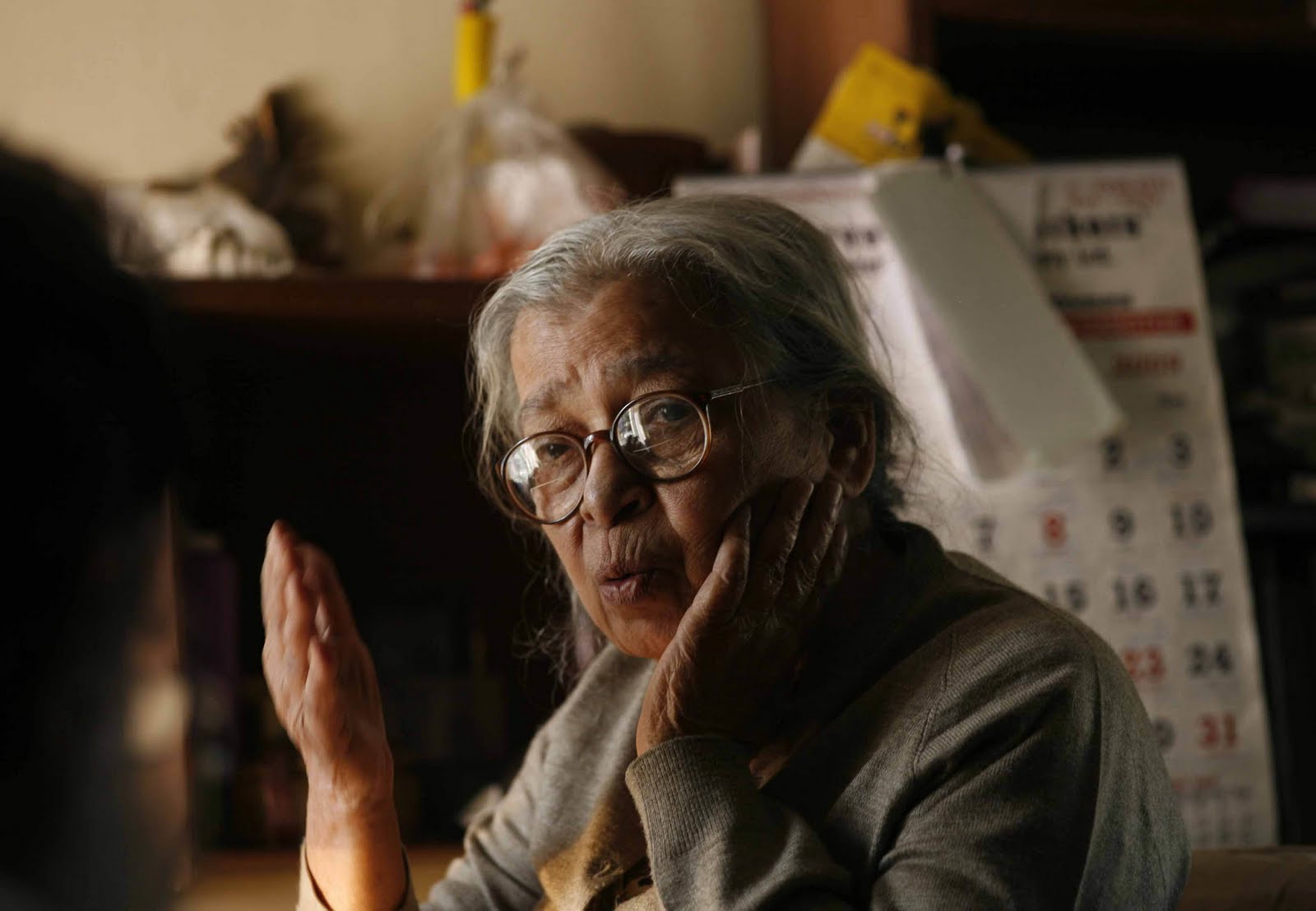
Talk to Maoists else Dantewada will repeat: Mahasweta Devi


New Delhi, Apr 15 (UNI) Strongly reacting to the recent Dantewada massacre, eminent writer and Magsaysay award winner Mahasweta Devi today said such incidents would continue to happen if the government does not talk with Maoists.

''The government, especially the country's Prime Minister, should go and talk with the tribals. If he does not do so, more and more tribals would turn into Maoists creating more menace,'' she said.

She asserted that she was against any violence and killings and so did not want such massacres to happen again.

The rebels had killed 75 Central Reserve Police Force (CRPF) troopers and a Chhattisgarh policeman in Dantewada district in Chhattisgarh in the worst ever attack by the Maoists.

Expressing her concern to the community, she said, ''Government is selling India, its states, its soil, its water inch by inch to the corporates under Special Economic Zones (SEZ). This is the greater menace which should be stopped immediately.''

While talking to UNI, she reiterated that condition of tribals in India was really bad, in fact worse beyond imagination. ''Wherever there are mineral rich lands, tribals are evicted from there and lands are sold to big corporates. Our government is bad to have been doing so with the weaker sections,'' she said.

The condition was similar everywhere in the country, be it Orissa, West Bengal, Jharkhand or Chhattisgarh, she added.

The social activist was in the Capital today to receive Manavata Vikas Award for her commitment towards the society. She was presented with a gold medal, a citation and a cheque of Rs 5 lakh as part of the award, instituted by Indian Institute of Planning and Management (IIPM).

''Whatever money I get in such awards or from anywhere else, it all goes to the tribals. It is worth only if is used for their welfare,'' she said.
----------------------------------------------

Saturday, April 17, 2010

CW writers deny giving space to climate change in their fiction


New Delhi, Apr 11 (UNI) Award-winning writers in the Commonwealth region believe that writing about climate change and getting involved in the global warming discussion is not their forte.

Expressing their immense love for fiction, they feel discussing climate change in their books and making the world leaders and their people realise their duties to bring about a revolution is calling for friction.

''We love fiction, but not friction,'' they say.

Regional winners of the Commonwealth Writers’ Prize 2010, to be held here tomorrow, are in the Capital to promote quality literature through a series of discussions and events among the people.

As a part of this run-up to the event, a panel discussion on ''Writing in a Changing Climate'', hosted by Crossword bookstore, was held last evening. It was attended by three of the finalists - Daniyal Mueenuddin, Shandy Mitchell and Michael Crummey who
interacted with young readers on the topic.

''You are trying to use a wrong instrument. Fiction is about describing things but not taking any positions'', Mueenuddin a writer from Pakistan, said. He has won critical acclaim with his first collection of stories- 'In Other Rooms and Other Wonders'.

Supporting his view, Mitchell, a Canadian writer, said, ''This is true. I cannot imagine myself taking a position to convince others. The non-fiction world is enough for that''. Her first book 'The Unbroken Sky', has been nominated under the Best First Book prize category.

She asserted that fiction writers write with naturalism and never with a set mind. '' The ideas keep generating while you write. However, if writing for climate change, then it will be for a purpose, a purpose that’s may be politically motivated,'' she said.

Crummey, another Canadian writer whose book ''Galore'' has been shortlisted in the Best Book category, added, ''If one starts writing with a political motive, 99 per cent it will come out as a bad fiction''.

He explained, ''What is important for a fiction novel is a good story because only that can travel, irrespective of what message it passes on''.

However, this thought process of the writers making them shy away from such an important issue left the audience disappointed, who also put their point in front of them.

''If one goes back to the history, he will find that writers have done wonders in bringing about a change in the mindset of people and society as a whole. I can feel that you are undermining your capabilities'', Ashok Sehgal, a banker, pointed.

Commonwealth Foundation’s director Mark Collins was also present on the occasion.

The Commonwealth Writers’ Prize organised and funded by the Commonwealth Foundation, is a leading award for fiction that was first awarded in 1987. The aim of the prize is to encourage new Commonwealth fiction, and to ensure that works of merit reach a wider audience outside their country of origin.

Wednesday, February 17, 2010

It Happened That Night: A tale of love, falsity and murder

New Delhi, Feb 14 (UNI) Tales of love and deceit, choosing between love and career and the like are not eccentric, still every story is able to interest people with as much thrill and excitement.

Joining as a link to such stories is 'It Happened That Night', a tale that subtly touches the strings of human emotions which gets entangled in confusions over tempted professionalism and repercussions of pressure.

Written by first-time author Akash Verma, a management graduate currently working in a media company, the novel is an extensive piece of fictional writing.

Noted Irish writer Oscar Wilde had once said, ''There is always something ridiculous about the emotions of people whom one has ceased to love''. The author has tried to put forth an example of his understanding of the same.

Verma has used rich style of fiction to highlight the inherent attributes of satanic clashes of ego, work pressure, compromises, struggle with truth, grievances and not to forget, the side-effects of life of 21st century.

''The message that the book conveys is 'Speak up and create a change'. I have tried to focus on the psyche and mindset of Indian middle class that impacts the socio-economic and political dynamics of the country,'' he says.

Verma explains, ''Metros are the first one to diagnose and bear the brunt of this dangerous syndrome. Some visible scars are murders, rapes and arson in broad daylight. ''

The novel is a journey of a 28-yr-old modern Indian professional working in a Multi-national Company and is caught in between the maze of love, a high-end job and the witness to a cold-blooded murder of a colleague.

The story takes the reader to the year 2002 when Gujarat, the birthplace of Mahatma Gandhi who is a synonym for non-violence, along with the entire country, was pushed back into global obscurity due to grisly riots that spread across the land.

''Chandan Mathur, the protagonist, realises and decodes life in its various human forms in the city of Ahmedabad. As his life takes him to various harsh and pleasant phases of life, he tries to find an answer to if he should listen to his own conscience or succumb to somebody else's demand,'' the writer says.

Wednesday, February 10, 2010

Students dismal by foreign publishers at World Book Fair


New Delhi, Feb 7 (UNI) Foreign publishers at the 19th New Delhi World Book Fair might have found a place in Indian market by only displaying the books at their pavilions, but this has led to downheartedness of many young buyers.

Many students, aspiring to pursue higher studies in foreign nations, had to return disheartened from the foreign publishers' pavilion during the fair as they could not buy and take the required books with them.

''I had been waiting for the fair and was thrilled to find those books which I wanted to read. However, I am not able to buy them as they are only on display,'' Manish Marwah, a student of foreign language, told UNI.

It was bad news not only for those students who read for pleasure, but also who required the books for their higher studies.

''I have to make a research report on German literature. Most of the books which I require are exhibited here. But I cannot take them with me,'' Sarita, pursuing M Phil in German language from Delhi University, said while turning the pages of a German novel at the German pavilion.

She added that although some German books are available with one Indian publisher in the other hall at the fair, they deal with German grammar only, not literature.

Nearly 35 foreign publishers from 18 different countries participated in the fair this time. For most of them, like Moscow, Israel, Germany and France, business opportunities were more important than selling their works to the visitors.

''We are focussing more on exploring the Indian publishing industry. Although promotion of our literature is important, but to find it's place in the Indian market is also necessary,'' a participant from Colombo said.

Realising the student's concern, some publishers had made sitting arrangements inside and around their pavilions also to attract readers.

Nevertheless, the idea could not please many.

''How can you expect me to work on my reports at a fair where there is too much of noise and disturbance! I wish they could have a photocopier machine if not the books on sale,'' Mathew James, another student learning Spanish language, said.

Thursday, February 4, 2010

Taslima Nasreen reiterates ''No Country for Women''


New Delhi, Feb 4 (UNI) Controversial Bangladeshi writer Taslima Nasreen is back with yet another book: a compilation of her works on the plight of women.

In ''No Country for Women'', a compilation of her best articles, the author has uninhibitedly talked of the condition of womenfolk, intending to ask them to come out of their shells and speak their mind.

The publisher of the book, Vitasta Publishing Pvt Ltd, has displayed the book in its stall at the ongoing 19th New Delhi World Book Fair.

''Nobody can hide from the fact that where there is Nasreen, there is controversy. We are meeting both fans and critics of her at the stall,'' Renu Kaul Verma, Publishing Director of the publishing house, told UNI.

Nasreen has strongly advocated women to bid adieu to their submissive attitudes and fight for their dues which are rightfully theirs but unfortunately not allowed.

She states, ''...behind the powdered faces of the elite society lies the stark reality where law is violated with impunity and where a woman is not regarded as a human being... she is a thing to be exploited, molested and raped....''

Sharing an incident that happened at the publishing house's stall yesterday, Ms Verma said, ''A person came to us and asked if we had any policy by which he can return the book. When asked the reason, he said he read the first two chapters of the book and could not digest it further.''

''Not everybody is able to handle her bold articulation and sharp presentation easily,'' she added.

Priced at Rs 245, the book has already sold more than 30 copies in two days. ''We are hopeful to find more readers and takers of the books till the fair ends and even later,'' Ms Kaul said.

Rediscovering Nehru: Delighted readers, depressed buyers at WBF


New Delhi, Feb 3 (UNI) Aiming to rediscover Jawaharlal Nehru, an exhibit of books on and by the visionary leader at the ongoing 19th New Delhi World Book Fair here is receiving a mixed response by the Indian history lovers.

While some visitors were feeling dejected when informed that the books at the exhibit were only on display, the others were enthralled to see the film series on
the first Prime Minister of an independent India being showcased at the stall.

More than 400 books on and by the leader have been displayed at the exhibit. However, booklovers are returning home depressed on learning that the same are not for sale.

''The books should be available for sale. A week-long book fair is not enough to know about a person like Nehru,'' Sanjay Sharma, a businessman, told UNI.

Nishant Mishra, a student of BA (Hons) in History from Delhi University, was also disheartened. ''I have to make a project on the life of Nehru and the best books are
available here. However, I cannot take them home,'' he rued.

The collective exhibit has been set up by the National Book Trust, the fair organiser, with the help of Nehru Memorial Museum and Library that has houses books in various languages, including English, Hindi, Telegu, Kannada, Malyalam,
Gujarati, Punjabi, Bangla, Marathi, Oriya and Urdu.

The organisers have suggested a solution to those interested in adding the books to their collection.

''The visitors can note down the name of the book and its publisher and then buy it from the stall of the respective publisher at the fair,'' NBT assistant editor in Telegu Pathipaka Mohan said.

And in case the readers have time at their disposal, the exhibit also has a proper sitting arrangement where they can read for hours together, he added.

Books like 'Chacha Nehru' by Mulk Raj Anand, 'Don't Spare Me Shankar', a collection of cartoons on Nehru by renowned cartoonist Shankar, 'Selected Works of Jawaharlal Nehru in 39 volumes', 'Jawaharlal Nehru Centenary Volume', 'Speeches by Nehru' among others, are up for display.

Mr Mohan informed that most of the books at the exhibit have been borrowed by the Nehru Library situated at the Teen Murti Bhawan here.

Another elderly visitor, V S Ahlawat, was really pleased looking at the books on the display. ''The titles have not only talked about a statesman and a visionary leader but have equally acknowledged authors too,'' he said.

One of the other major attractions at the collective exhibit is a film series on Nehru being showcased daily. Called the 'Nehru Bioscopes', the shows have been organised by the Film Club of Nehru Memorial Museum and Library.

The films being shown include 'Nehru' by Shyam Benegal; 'Vision of Independent India: Nehru' by N S Thapa; 'Nehru: A Pictorial Biography' by G S Raina and
'Bharat Ek Khoj', an acclaimed television serial by Shyam Benegal and others.

The movie series are attracting visitors, both youth and elders, alike.

Pranab 'Da' is the 'sea anchor' of Central govt: Ansari


New Delhi, Feb 3 (UNI) Praising him to the skies, Vice President Mohd Hamid Ansari today called Union Finance Minister Pranab Mukherjee as the best consensus builder who is a critical part of good governance.

''Mr Mukherjee has the ability to make complex situations easier, come out with solutions acceptable to all and most importantly, build consensus around various situations,'' Dr Ansari said.

Calling the Minister as Pranab 'Da', the Vice President said Mr Mukherjee was the 'sea anchor' of the government.

He was speaking while releasing a coffee table book 'Pranab Mukherjee: The All Season Man', here at the 19th New Delhi World Book Fair. The book has been written to pay tribute to the leader on his successful completion of 75 years last December.

The Finance Minister, who was also present on the occasion, congratulated the editor and his colleagues for bringing out such a book. ''I hope people would like the book leading to satisfaction to me, the compiler and others,'' he said.

The book is a compilation of first person accounts, memoirs and thoughts by different eminent personalities from different walks of life.

People like Prime Minister Manmohan Singh, UPA chairperson Sonia Gandhi, former Speaker Somnath Chatterjee, Minister of State for External Affairs Shashi Tharoor, Indian skippers Kapil Dev, Mohd Azharuddin, veteran actor Mithun Chakraborty,
pop music maestro Bappi Lahiri, business tycoons S K Birla, R P Goenka, among others, have contributed their thoughts on the minister in the book, editor of the book Sukhendu Sekhar Ray said.

The book is priced at Rs 1500 and published by Deep Prakashan, a Kolkata based publishing house.

Mr Tharoor was also present on the occasion.

Wednesday, February 3, 2010

'Jahan-e-Rumi' portraying Sufi mystic's life enters World Book Fair


New Delhi, Feb 2 (UNI) Opening up the treasure of mysticism of Sufi saint Rumi for Urdu readers, a book on the great poet's life was released by the Ministry of Information and Broadcasting here today.

Written by Mirza Abdul Baqi Baig, a doctrate from the Jawahar Lal Nehru University, the book, ''Jahan-e-Rumi'', encompasses life history of saint Rumi.

''The book has beautifully mentioned about the spiritual journey Maulana Rumi traversed and his contributions to the humanity,'' Madhukar Upadhyaya, renowned journalist and author, said after releasing the book at the ongoing New Delhi World Book Fair.

Comparing the saint's writings with the Darwin's Theory of Evolution, he said, ''The Sufi mysticism the Persian poet had putforth, continues to have a universal appeal even today.''

The writer of the book emphasised that it was the ongoing demand by the Urdu readers which made him write the book in this language.

Talking about the saint, Mirza Baig said Rumi was the descriptive name of Maulana Jalaluddin Mohammad, who was the 13th century poet, jurist, theologian, along with a great Sufi mystic.

He informed that it was the second book till now on the life of the philosopher. Earlier, writer of Sufi literature Trinath Mishra, who was also present on the occasion, had written about the saint in Hindi.

A symposium on the subject, ''Bhartiya Sanskriti Mein Sufi Mat Aur Rahasyawadi Parampara ka Yogdan'' (Contribution of Sufism and the Syncretic tradition to Indian Culture) was also organised after the book release ceremony.

Along with Mr Upadhyaya and Mr Mishra, senior Urdu scholar Siddiqurrahman Kidwai and Director of Publications Division Neeta Prasad with other officials of the Ministry participated in the discussion.

Monday, February 1, 2010

19th New Delhi World Book Fair to highlight Reading on Commonwealth


New Delhi, Jan 28 (UNI) The 19th New Delhi World Book Fair is all set to begin on January 30 with ''Reading our Commonwealth'' as its theme this year.

With nearly 2400 stalls and stands representing nearly 1200 Indian and foreign publishers and exhibitors, the biennial fair is organised by the National Book Trust here and this year, they will be focussing on Commonwealth Games ahead of the national capital holding the same in October.

''It is an attempt to find a connection between the world of books with that of sports through the theme this year -- Reading our Commonwealth: An International Rights Exhibition of Books on Sports,'' Chairman of National Book Trust Bipan Chandra told mediapersons here.

Nearly 700 titles published by around 75 publishers across the country on different genres of sports will be exhibited at the theme pavilion, he said.

''A special International Rights Catalogue, with bibliographic and copyright details of more than 550 titles, based on this exhibition has also been brought out and it will be released on the inuagural day,'' Mr Chandra informed.

The fair, to continue till February 7 at Pragati Maidan, will be inaugurated by Union Human Resource Development Minister Kapil Sibal. Eminent historian Prof Irfan Habib will grace the occasion as the Chief Guest while Dean of School of Humanities and Education, North Eastern Hill University Prof Temsula Ao will
preside over the function.

Mr Chandra expressed concern over the fact that this book fair was the only one to be held once in two years. ''We have requested the HRD Ministry several times that it should be held every year. For that, it is necessary for them to increase our minimum grant to at least Rs 18-19 crore,'' he said.

Spread over an area of 42,000 sq meters, the fair will have different stalls for both Hindi and English language publishers and distributors, Science and Technology books publishers, foreign participants, educational book publishers, Social Sciences and Humanities books publishers, Indian regional language publishers, children's books, and others.

Speaking more about the theme pavilion, NBT Director Nuzhat Hassan said the theme pavilion would house children and youth pavilions also and various interactive sessions would be organised with some eminent sports personalities like star athlete Milkha Singh, badminton topshot P Gopichand, to name a few.

Some classical documentaries on sports events and adventure sports produced by the Films Division will be screened at the pavilion, along with many workshops, quiz competitions and storytelling sessions, she added.

''Altogether 33 programmes have been scheduled by various agencies including NGOs and schools,'' she noted.

Ms Hassan further said a special exhibit of books on and by Jawaharlal Nehru to showcase his contribution to the world of books has also been organised at the fair.

The fair will also have three special areas where people are invited to hold any kind of a programme related to books of their choice.

Referring to Pakistan as one of the participants, she said many private publishers from the neighbouring country would be exhibiting in the fair. ''However, the country's national book body, National Book Foundation, denied yesterday,'' she said.

On being asked about the reason, she said, ''We do not know.''

About the entry tickets to the fair, she said students in school uniform accompanied by their teachers would be given a free entry to the fair. Else, the ticket remains Rs 20 per adult and Rs 10 per child for others.

==========================================

KASHMIR TIMES

Pak's Natl Book Foundation cancels participation in Book Fair


New Delhi, Jan 28 (UNI) The IPL fiasco has also cast its long shadow over the New Delhi World Book Fair to be held here from January 30 as the National Book Foundation of Pakistan backtracked from its participation in the nine-day event.

The decision comes hard on the heels of the neigbour country's Chief Election Commissioner and a parliamentary delegation cancelling their visits to India recently.

National Book Trust Director Nuzhat Hassan told mediapersons here today that the Foundation, based in Islamabad, had declined to attend the fair yesterday itself.

''We are disappointed over this. However, there are other private publishers from the country who contacted us directly and will be exhibiting at the fair,'' she said.

On being asked about any particular reason, she replied in negative.

With nearly 2,400 stalls and stands representing nearly 1,200 Indian and foreign publishers and exhibitors, the biennial fair is organised by the National Book Trust here.

A Pakistani parliamentary delegation had cancelled a visit to India a week before after none of the country's cricketers were chosen to play in the the third edition of the Indian Premier League (IPL) in March.

Pakistan's cricketers played in the first IPL tournament in 2008, but were not allowed by Islamabad to travel last year due to the tensions after the Mumbai terror attacks.

Tuesday, January 26, 2010

Korea's First Lady presents Tagore Literature Awards 2009


New Delhi, Jan 25 (UNI) Honouring excellence in fields of art, literature and culture, the First Lady of the Republic of Korea Kim Yoon-ok presented the first Tagore Literature Awards to eight Indian luminaries here today.

In a glittering ceremony, the experts were awarded for their contributions in eight Indian languages -- Bengali, Bodo, Gujarati, Hindi, Kannada, Kashmiri, Punjabi and Telugu.

In the poetry genre, Bengali poet Alok Sarkar won the award for his book 'Apapabhumi' and Kashmiri poetess Naseem Shafai won for her collection of poems 'Na Tshay Na Akas', while in the autobiography section, Gujarati author Bhagwandas Patel won for 'Mari Lokyatra' and Punjabi writer Jaswant Singh Kanwal
won for 'Punya Da Chanan'.

Similarly, there were two winners in the essay section, namely Bodo writer Brajendra Kumar Brahma, who won for his book 'Raithai Hala', and Telugu writer Kovela Suprasannacharya, who won for his book 'Antharangam'.

In the genres of short stories and novel, there was single winner each. Hindi writer Rajee Seth won for her collection of short stories 'Ghame-Hayat Ne Mara', while Kannada novelist Chandrasekhar Kambar won the award for his novel 'Shikara Soorya'.

The awards have been instituted by Sahitya Akademi in collaboration with Samsung Electronics.

Asserting that the awardees had been selected in a much democratic manner, president of Sahitya Akademi Sunil Gangopadhyaya explained the selection procedure to all present in the gathering.

''Altogether 188 scholars from different languages constituted the selection committee who chose the winners after a three-stage procedure,'' Mr Gangopadhyaya said.

The awards will recognise the best literary contributions in eight different Indian languages every year, with 24 languages being covered by the end of the third year.

The same cycle of eight languages being rewarded every year will continue thereafter.

Replying to a question that why the winners did not include any young poets and writers, Mr Gangopadhyaya stated that since it was the first year of the awards, it was decided to honour the veterans first.

''However, if any other country or a big business house offers us to give award to more poets and writers, then they are welcome,'' he quipped.

He noted that the initiative taken by the two countries was a fine gesture leading to promotion of Indian literature as well as cultural and literary bonds between the two.

Speaking on the occasion, president and CEO of Samsung South-west Asia Headquarters J S Shin said, ''The awards are celebrating the power of literature to unify people across, regions and cultures.''

The awardees were honoured with a trophy, a cash prize of Rs 91,000 and a shawl.

The ceremony was followed by a recitation of Tagore's poetry by an Indian child, Somoshree Mahapatra, and a Korean child, Jihun.

Noted actress Sharmila Tagore was also present on the occasion. As the children recited the poem, she was so overwhelmed by their performance that she ran up to the stage to kiss the 12-year-old Korean boy.

However, Jihun much later came to know that he had got a peck on his cheek by a veteran Indian actress.

The evening had a fitting finale with the rendition of a collection of Tagore music on 'sarod' by the famous duo and sons of Ustad Amjad Ali Khan, Aman Ali Khan and Ayan Ali Khan.

Mr Yoo In Chon, Minister of Culture, Sports and Tourism, Government of Korea; Mr Jawhar Sircar, Secretary, Indian Ministry of Culture, Prof Pabitra Sarkar, former vice-chancellor of Rabindra Bharati University and Dr Reba Som, Director, Rabindranath Tagore Center, Kolkata, also graced the function.

Thursday, January 7, 2010

Victim of ragging mostly rags a junior: HC Justice Gambhir


New Delhi, Jan 7 (UNI) Terming ragging a ''venomous practice'', Justice Kailash Gambhir of the Delhi High Court noted that a person who ragged a junior must have been a victim of ragging himself.

''When a person gets ragged, its germs are sown inside him which bounce back when he becomes a senior,'' Justice Gambhir said and added that ragging was violation of human rights that distorted mental balance of the victim to an unimaginable extent.

He was speaking on a launch ceremony of a book entitled ''Ragging - The Red Alert'' held here recently.

He added that ragging was no more a means of interaction but more of teasing and humiliating juniors that distorted the balance of an individual.

Judge of the Delhi Consumer Court Dr Premlata, who was also present on the occasion, asserted that there was a need to go to the root cause of the problem.

''Today's youth is aggressive. They get sadistic pleasure in teasing somebody. We have to be concerned about the emergence of this behaviour,'' she said.

Talking about his inspiration to right the book, its author Gulshan Naveen said the sad demise of Aman Satya Kachroo, who died in March last year due to intense ragging by his seniors in Himachal Pradesh, made him to raise his voice against the evil.

''The character of ragging is becoming downright criminal. Today's raggers are learning from various sources and beginning to indulge in atrocities of the kind inflicted on prisoners confined in Guantanamo Bay!,'' Mr Naveen said.

The country has not been dealing with a simple law-and-order problem but a cancer that was degrading the society, he added.

Father of Aman and head of an NGO, Aman Movement, established to work towards eradication of ragging, Dr Rajendra Kachroo also attended the function.

The book gives various circulars of UGC, AICTE as also deep intervention of courts, including the Supreme Court of India. It refers to the possibility of an increase of virulent events in technology education institutions and suggests that present college education has a deficiency in liberal education.

''Educational institutes need to move in a direction to provide more of practical knowledge to students instead of delivering lectures on morality and good behaviour,'' the book mentions.