Showing posts with label Education. Show all posts

Tuesday, February 7, 2012

The reel communication!

If you have an insatiable passion for telling a story that will enthrall an audience, go for this medium


FILM, television and radio are powerful media as they reach people regardless of age, sex, income, or educational level. “Television and films offer sight and sound, and make dramatic and life-like representations of people and products whereas radio creates impact with the help of sound effects,” says Prof. Ashok Ogra, Director, Apeejay Institute of Mass Communication, who has worked with Doordarshan for 15 years.

With the advent of liberalisation, both film and TV have exploded in their reach and growth. India currently produces the world’s largest number of films and at the last count has over 800 TV channels offering news and entertainment. Same is the case with FM radio after the sector was opened to the private sector. A recent report by KPMG says the employment potential of the sector is going to treble in the coming five years.

The ‘reel-life’
So what goes behind creating this ‘reel-life’ experience? Every programme (film, TV serial, and radio) has one common stage in the order - concept, story, script, production, post-production, release and display. Irrespective of the medium, concept stage is very important. Based on it a story line is made which is further made live in the form of a script. Once the script is ready, it is the production team’s responsibility to give it a real shape. Then further editing and polishing is done in order to make it more presentable before finally releasing it to reach the public.

Aparna, a dialogue writer, shares her experience on the job. She says that a dialogue writer creates the conversation and builds moments while working on each scene and character in the screenplay. He or she is also responsible for creating characters’ accent or dialect. “Making each scene interesting by adding emotions, one liners, some quirk, some comedy, romance or even anger is interesting,” she says. Aparna has worked on at least eight feature films including Aisha, Chance pe Dance, LSD and Yeh Saali Zindagi and has also been independently writing for TV shows.

She adds, “I love my profession because it does not feel like a ‘job’. There is lot of creativity and liberty in what I do. You would usually see writers working through the night, preparing scripts for the next day’s shoot. So this field is definitely not time-bound. I love talking, communicating, meeting various kinds of people. This helps me in developing characters and creating moments.”

Career scope
A plethora of job opportunities are on offer such as producer, director, script writer, reporter, anchor, sound recordist, editor, cameraman etc as each film or a TV programme would employ a number of people at different stages.

The best part of choosing this area is that one can opt for working with a production house or broadcasting organisation. A person can also work on a freelance basis. Apart from this, there are jobs in the advertising agencies, Personal Relations and Event Management firms and in academia.

Prof. Ogra shares, as per the KPMG-FICCI 2011 report, the Media & Entertainment industry is expected to be of the staggering size of over Rs.127,5000 crores by 2015, up from the level of Rs. 73,800 crores in 2010. “This growth is bound to give a further fillip to this field. So, I have a very positive recommendation to all the aspiring professionals,” he says.

Develop a skill-set
To start with, there are a lot of colleges which offer training in all the options mentioned, including both short-term and long-term courses. Most of them can be pursued after graduation. But apart from regular studies, a person should have a passion for it. He should be an avid observer of nature, human emotions and different cultures. Besides having the knowledge of the domain, the person should have good knowledge of different art forms, which not only helps the person to perform well but helps him or her to interact with other team members. Also, the person should have an attitude to welcome the critics, good interpersonal relationship, imagination, creativity, and above all patience. The industry offers not only jobs but career growth in all related areas; depending on determination and area of work.

“Actor, a statue of hope!”

Meet Deepesh Bhan, a struggling actor who believes that a performer is ‘ummed ka putla’ (statue of hope) who must keep his or her will power intact to succeed. Starting his career through a comedy show ‘Comedy ka King kaun’ of Balaji Telefilms and acting in many advertisements, he is now working in a couple of popular TV soaps including FIR.

Q: Your journey till now?
A: Struggle is at every stage while glamour takes long to come. After being in theatre world for four years, I came to Mumbai seven years ago. Though it is tough, but now I am sailing through.

Q: Is the first break tough?
A: Audition is not the beginning. You are tested for the way you talk, walk, stand etc. Even when people say “Wow! That was good”, it’s not sure that you’ll hit the chord.

Q: Why shift from theatre to TV?
A: You can’t earn your living from theatre. There are many examples in our film industry who made this shift, though the passion remains.

Q: Is language important?
A: Yes, viewers relate to a character through the language he speaks. So, one has to be perfect. Being from north India, I worked well in roles as of a boy from Haryana, Punjab or UP, but I faced problem when I was given a role of a Gujarati boy.

Wednesday, February 1, 2012

Not just cooking!

Apply science for a better living including good food and nutrition, clothes, hygiene, consistent development, communication and good community living. Home management is only a small component of the discipline.


HOME Science is the application of science to bring home and family life in sync with changing surroundings, and even today the programme is only open to women. Projects in each subject and lab practical are a regular feature in the academic life of Home Science graduate

“Some needed lots of effort - like identifying a child labourer in our locality and developing his or her profile,” says Ritikaa who passed out of Institute of Home Economics. She also says, it is not just about cooking, which is a common misconception. She is currently pursuing Master’s in Psychology and working as a special educator and counsellor at a school.

Scientific techniques are taught to cope up with day-to-day problems and field project works are done to learn their application. The course helps in overall personality development of the person.

In case of BSc (Home Science), a student gets a chance to choose his or her specialization in the third year. For example, Manav Rachna International University (MRIU) offers a BSc, MSc and diploma programmes in Nutrition and Dietetics. “Our programmes specialize a student directly in the food and nutrition field. Lifestyle diseases are on an increase and people are getting more conscious about their dietary habits. So, the subject is gaining importance,” said MRIU’s Dean Dr. G L Khanna.

Home Science graduates can opt for an array of career options in food sciences, sport academies as personal consultants and even MNCs hire them for the wellbeing of their employees. Nutritionists and dieticians also have openings as researchers in natural food making companies like Dabur. The salary structure for an undergraduate starts between Rs. 10,000 and Rs. 20,000. If they pursue postgraduation then they can earn even Rs. 40,000. And for those with experience, the package will increase manifold.

A career for compassionate minds!

Art of self control and understanding of a human mind and heart are the mantras for a teacher of special children.


CHILDREN with disabilities are so special that a person working for them has to have a mind which can understand and comprehend situations as well as people. “The job is not easy. People need to have the art of being patient, good presence of mind, compassion and commitment to duty,” says Aparna Babu who is working with children with special needs for many years now.

Any 10+2 student, irrespective of what stream he had in senior secondary can pursue a course in this field. There are degree, diploma and certificate courses available in various colleges in the country recognized by the Rehabilitation Council of India (RCI). An aspirant can choose to study to work for visually impaired, hearing impaired and/or mentally retarded persons. There are specialized degree programmes available in the fields of Locomotor and Cerebral Palsy, Autism, Vocational Counselling, and care giving.

These programmes train students for a whole range of services for children with disabilities. Special schools are on a rise in the country along with major non-governmental organizations (NGOs) who are concentrating their energies and resources to set up help in this particular avenue. “As per the new Inclusive Education paradigm, all the children would be in the same class, studying together irrespective of abilities. Therefore, special teachers, facilitators and guides with this degree are required for this endeavour,” Aparna explains.

As far as the salary structure is concerned, the package may not be that high. As a teacher one can receive what the teachers receive according to the 6th Pay Commission as per the grade whereas counsellors receive more. If we were to give a starting range, one could begin between Rs. 9000 to Rs. 15000 depending on the profile.

The task is challenging because people in this field need to have the art of self control and knowledge and understanding of a human mind and heart. A person needs to be mature enough to deal with any situation, especially the unexpected ones. So though a 10+2 student can look forward to a career in special education, he or she should have a detailed study of how to understand and empathise with special children. “A developed, mature understanding and a strong sense of mind is the need more than age. So if a student of 17 had the passion to work in this field, I would just say, come on board to build our society,” Aparna stresses.

For this reason, a little extra knowledge in terms of higher studies is also advisable. Moreover, there is growth in position in any particular organisation on the basis of the educational qualification. But the amount of satisfaction attained is incomparable.

If not MBBS, be a paramedic!

Paramedics are the professionals who support both the doctors and patients simultaneously. Patience is their most-needed quality.


AS soon as you visit a doctor for any ailment, you are led to a lab and tests are done. Who performs this necessary task for you? Doctors? No, they are the paramedical professionals. Optometry, Radiography, Lab Technology, Physiotherapy, Occupational Therapy and Rehabilitation are some of the prominent disciplines in allied sciences.

Admission procedure & job scenario
It varies from institute to institute. It has been felt that the paramedical staff does not get due recognition at times and that is why courses at Master's and PhD level have been started. But at an operational level, a paramedical job does not require higher studies but field experience is most important. Most institutes prefer to admit students through national-level admission tests while others through state/institute level tests. Here is a ready-reckoner.

Good news is that finding a job in this area is easy once you have your degree or diploma as no hospital or clinic can run without a paramedical staff. Anurag Saxena of RP Centre for Ophthalmic Sciences in AIIMS says, “Students pursuing the course are able to find part-time jobs in their first year itself at a stipend of around Rs. 7,000. After completion of the course, the salary begins from Rs. 15,000 and if the person has some part-time experience, he can get even higher.”

Self-Employment
Apart from working in clinics and hospitals, you can work from home and become self-employed also, like a physiotherapist. One may find a physiotherapy centre within a 3-km-range. But yes, then investment is a concerning factor as machines used are expensive. Paramedics can also go for clinical research after pursuing further studies. Read more...

Conclusion
It is team work and the person has been supportive to both the doctor and the patient at the same time. “Patience is the most important quality paramedics should have. They should be able to listen to the patient and understand his need all the time with a smile,” says Treta, who pursued a course in pathology. Other qualities include ability to work for long hours, good scientific vocabulary and fine presence of mind.

A world in a Handset


Over 80 crore mobile phone users are in India, offering a world of opportunities in mobile content space. This industry needs a lot more than just technical skills.


THE ‘special and very clever’ men in dark suits are indeed making way for boys and girls next door – people like us – as has been affirmed through song and dance by that famous BlackBerry advertisement. The other day even a friend of mine showed me his newly acquired smartphone and some of the things he does on it.

“I Gtalk, gmail, use Facebook, play Angry Birds, watch videos, read books, newspapers,” he told me excitedly. I thought I was as impressed by the prodigious functionality of that gizmo as I felt curious about the scores of people who made a mere handset perform all those interesting activities. Aren’t they the people who should be called ‘special and very clever’?

The world of mobile content
Today, a suitable mobile phone device allows us to do an ever-widening range of things. Collectively known as mobile content, such things could be games, wallpapers, ringtones, video, mobishows, news, maps, Live TV, Radio, music, and SMS-based services and applications or apps. Indeed, mobile content is increasingly matching anything that a laptop computer can do. The experts like to classify mobile content into three main categories: Mobile entertainment, Mobile apps, and Mobile games.

Just like various applications that we run on personal computers, use of mobile content also depends on the operating system (OS) of the cell phone. Broadly, there are eight operating systems used in the cell phones: iOS, Blackberry OS, Android, J2ME (Java 2 Platform, Micro Edition), Brew (Binary Runtime Environment for Wireless), Windows Mobile, HP webOS and Symbian OS. Their superior user interface (UI) has made Android OS and iOS the most popular these days. While an Android OS, for instance, will allow you to change the default web browser on your mobile handset with the touch of a few buttons, a Symbian OS will not.

A business and a brand
India’s mobile phone subscriptions have grown phenomenally in the last decade to reach over 80 crore, a huge market for phone service providers as well as other companies to tap by investing in mobile content, such as games and videos. Often referred to as Value Added Services (VAS), such services help companies increase their revenues and improve their brand awareness.
“Growing penetration of smartphones has made it imperative for companies to invest in the content space. It is also financially attractive because consumers are willing to pay for good content,” says Rajasekar Raju KS, Director - Social Media Marketing, Impiger Technologies. The company has been providing text and video-based multimedia content to both Indian and foreign mobile subscribers for the last seven years.

It is quite a challenge for the companies to be able to make rich but memory-guzzling applications available on a small piece of hardware that a handset contains. A subscriber will not like to use an application that will take up the entire battery capacity in downloading just one page. And they may also like to have as many applications to run on their devices as possible. So companies now have dedicated R&D teams to create or adapt applications that will run smoothly on mobile devices.

At Adobe Systems India, for example, a team has been working on making a mobile phone-compliant version of Photoshop. “There are sub-teams working on moving Photoshop features online, design and development of licensing technologies, building user interface, and the look and feel of the website, etc,” says Sourabh, a computer scientist working with the company. Sourabh developed interest in the cell phone world while doing his B.Tech and then M.Tech in Information & Communication Technology at IIT-Delhi.

Creativity is the mantra
Mobile content is your field, if you like to create and experiment. For any job here, you require a great attitude and the ability to conceptualise. You should know, for instance, why the Superman had to be a strong, tall and handsome man and Pinoccio a lean boy. You would do well to be a good learner of emerging technologies in order to remain competitive. Also valued is your ability to understand the medium and users and some general knowledge. If you have seen games having characters resembling a film star or a politician as the protagonist, you will know they are there because of their relevance to the present scenario.

Education-wise, some technical competence is the first step. An engineering degree in computer science or Bachelor’s and Master’s in computer applications are good. Following that, short- term courses in graphics development, designing, visual arts, to name a few, will help you excel in this field. A regular student can do a course on the side or work as an intern in a company to learn the domain-specific skills.

“I did a course in J2SE (a platform of the Java programming language) from NIT-Silchar under AX LABS. I also learnt J2EE (a Java-centric environment for developing Web-based applications) and gained hands-on knowledge by working as an intern at 2ergo, a company providing mobile-phone marketing and messaging services,” says Devansh Mohan Kaushik, a third year student of Electronics and Communication Engineering at NIT- Agartala.

The job arena
The mobile content industry has a place both for a programmer and a person with primarily artistic skills. An application begins with someone thinking about a concept which is then converted into a design. Features like movement of characters and sound are added to the design which is brought into action by a programmer. Before it reaches its final destination, a test run is conducted.

There is a wide variety of areas to work in. You can become a content writer, copywriter, scriptwriter, designer, audio and video production professional, voice rendition technician or programmer. The industry sees video and 3D content as its future and requires skills like radio jockeying, anchoring and videography. One can also start on one’s own by turning into an application owner, developer or distributor.

Manish, a contractual game designer, says he is happy being a freelancer than tie down with a single company. He has developed several games for the J2ME platform, including ‘Castle of Clouds’ and ‘Dilaer aur Dilrooba’ and is working on a game for iPhone. “I am enjoying it. As and when I am given an idea, I work on the game mechanics, that is, the rules of play and the user interface design (UI). At times, I try my hands on the look and feel of the game also,” he says.

A gadget industry needs engineering skills at every stage. An engineer has responsibilities from knowing the raw material until it is converted into a smart phone. Simple things which may go unnoticed by a user involve much research and development. “For a gamer there are plenty of issues to plug - issues like signal should not break down while driving, no interference from adjacent and core channels and proper signal in idle mode also,” says Saurabh Nangia who has worked as an R&D Engineer with Nokia. He did his B.Tech (Electronics & Telecommunication) from Guru Gobind Singh Indraprastha University before doing a six-month course in Telecom Engineering and Management at IIT-Delhi.

Challenges
Currently, it’s difficult to find specialised courses in mobile content in India. Spotting a job opportunity is also not easy. Content providers are generally dependent on the telecom service providers. “But with a bit of Google search and attending mobile application and VAS conferences, a career is not far away also,” says Rajasekar.

One needs a lot of patience, such as when browsers do not work right or a code will not validate. Application development goes through many processes. It takes days together to achieve that ‘little’ finishing. Meeting expectations of the client is tough. You need to develop the end product with whatever story-board or assets he provides. Getting noticed in this industry is a challenge too; you have to prove the quality and competitiveness of your product.

Then there are technical barriers, like deciding important elements of your application according to different sizes and types of mobile screens. You also take time to even understand the mobile browsers. When Manish entered the gaming industry, he was asked to fit graphics for the entire mobile game in less than 35 kb. “I had just come from the PC game industry that does not suffer from such enormous size constraints. Thankfully, things are really changing now,” he says.

Career progression
Remuneration depends on your performance. An entrant could kick off with Rs. 2.5-3.5 lakh per annum depending on the skill required. In three years, you could command Rs. 5-7 lakh per annum. An engineering graduate with programming knowledge can start at Rs. 4 lakh per annum reaching till Rs. 15 lakhs with experience. Most of the successful professionals have been found to own their own content development company or become an aggregator.

Satisfaction from the job is the key to rising higher. For a mobile content professional, success comes more in terms of enjoyment while working. You learn new technologies. You get to play with different types of graphics and also media elements.

Mobile content also offers Indians opportunities to work in other countries. However, foreign companies have been outsourcing their work to developing countries like India. So the opportunities are improving all the time. If you have the skills and the confidence, the whole world is there for you to work in.

“Outsourced business is growing in India.”

Q&A with Ram Warrier, Business Head, MAAC (Maya Entertainment of Advanced Cinematics)

Q: What are the qualities a gamer should possess?
A: A gamer must be a self-starter, setting goals for himself and does not need to be prompted what to do, but find solutions himself. He should be a good learner and understand upcoming technologies.

Q: Is making games for mobile different from other interface?
A: Yes. Games developed for mobile phones are optimised and not heavily programmed. They are art-intensive. It is a challenge in terms of looks, graphics, effects and navigation. This is why, the games on mobiles are developed for a mass market and they fall in the category of casual games.

Q: Is the Indian market looking up?
A: The Indian Gaming Industry is expected to reach 830 million by 2012. India is fast emerging as an important destination for outsourcing because of low-cost and high-quality advantage. Games developed in India have been successful internationally, enhancing India’s reputation for technical and infrastructure capabilities to provide services that meet international standards.

Q: What coursed do MAAC offer?
A: MAAC has a dedicated career programme in Game design and Integration (DGDI). It covers all nuances of game art, design and the integration of game asset elements including Digital Asset Creation and their integration in the game engine.

Q: What are the career opportunities?
A: A person can go for 3D Game Designs, Game Testing jobs, 3D Game Modeler, Web 3D graphics, game production, Interactive product demos and walkthroughs.

Q: And the pay scales?
A: A gaming artist or game tester draws a salary of around Rs. 10,000-12,000 per month. A programmer draws a salary up to Rs. 30,000 per month.

Wednesday, August 17, 2011

IGNOU plans conference to celebrate International Year of Chemistry


New Delhi : Indira Gandhi National Open University is organising a two-day conference on Chemistry to create more interest of the youth in the subject leading to more innovations on the occasion of International Year of Chemistry.

This day was proclaimed by the International Union of Pure and Applied Chemistry (IUPAC) and UNESCO.

The conference aims to address the issues pertaining to Chemistry Education and exploring the newer and emerging areas of chemical research. An added feature is the inclusion of a session dedicated to the role of women scientists in chemical research commemorating the Centenary of Madame Curie s Nobel Prize, Prof V N Rajasekharan Pillai, Vice-Chancellor, IGNOU, said today.

The Sir C V Raman Chair and School of Sciences (SOS) in IGNOU will hold this conference titled Chemistry: Education and Research Frontiers from October 13 in the national capital, a varsity official said. A series of invited lectures by renowned persons of international acclaim and oral/poster presentations by the young scientists will be a part of the event.

The university is inviting applications for submission of abstracts on the topic Frontier Areas of Chemical Research till August 22, the details of which are available on IGNOU website.

Tuesday, August 9, 2011

IGNOU, Aditya Birla Group jointly to train rural ppl in stitching


New Delhi, Aug 5: Indira Gandhi National Open University and the Aditya Birla Group will now together train rural people in garment stitching, a varsity official said.

The open university today inked a pact with Aditya Birla Nuvo Limited's wholly owned subsidiary Madura Fashion and Lifestyle Limited to impart necessary skills and training in garment stitching to the community members who are unemployed, under employed and are residing mostly in the rural, suburban and disadvantaged locations.

Three short-term non-credit courses -- Basic Certificate in Garment Stitching for one month, Advance Certificate in Garment Stitching for two months and Advance Certificate in Garment Stitching and Quality Control for two and a half months -- will be taught under this MoU.

All of these programmes will be coordinated by IGNOU's Regional Center of Delhi-1 at Mohan Cooperative Estate.

"Many organisations are looking for trained human resources and are training them as a part of their corporate social responsibility. Learners may even want to pursue these courses at a certificate or diploma level which may be provided to them in the later stages," IGNOU VC V Rajasekharan Pillai said.

Under the MoU, Madura F&L will enrol at least 200 students per year as per IGNOU approved eligibility conditions and conduct programmes at approved learning centres only. A special study centre will also be opened in Bangalore for the conduct of these courses.

Monday, July 18, 2011

Children have no "altitude " problem in community service


New Delhi, Apr 6 : Breaking all conventional barriers, Indian school children have surpassed their elders in community service from cleaning a dirty village pond to climbing 17,000 ft to collect 32 kg of garbage!

Ninth class student Sarojini Sarada turned a disused pond in her village in Orissa to a fish breeding ground providing an excellent business opportunity for the local people. She conducted a "Pond restoration mission" to clean the pond and motivated her friends and neighbours towards the cause.

Such is a story of not one small girl but hundreds of other students nationwide who put extraordinary efforts to serve the community.

Arun Vajpai, a XII class student from Haryana, trekked at an altitude of 17,000 ft over a period of two and a half months and collected 32 kg of garbage. It was his effort to free the people living on mountains from various ecological problems they face.

"We generally think that it is more than enough for school children to complete their homework. However, these children are not only doing well in their studies but have excelled in helping others," said Ms Sujata Dutta, founder member of Pramerica Spirit of Community Awards, organised for the first time to felicitate such students in the country on Monday.

Altogether 42 students, belonging to classes VI to XII, were shortlisted from around 600 such young volunteers and awarded medals and certificates. Two students received gold medals, a cash prize and a return trip to the US while 18 got silver medals and 20 bronze medals. Two students were also presented with Jury Appreciation Awards.

Mother to a seven-year-old boy, Ms Dutta, however, stressed that community service in India is not easy, especially for girls "When we talked to these children, we realised that there are problems like community acceptance, insecurity, and lack of encouragement, except in some cases where teachers and parents were the morale builders," she said.

Citing an example, she informed UNI about a VII class boy, S R Poobesh Gowtham, in Hosur, Karnataka, who felt strongly for the girl students of his school who had to go to toilets with no roofs.

"For construction of the covered toilets he had to raise money. When he talked about it to his friends, they used to laugh at him. But he did not feel demoralised and collected Rs 10,000 for the construction activity," she said.

Gowtham even educated children about the importance of toilet hygiene through skits, presentations and life-skills classes in his own school premises. He received a silver medal and a certificate for the same.

Emphasising that encouragement from teachers and parents can lead these students achieve greater heights, Ms Dutta shared the story of VII class student Nikkita Chhiber of St Mary's school in New Delhi who initiated a greenery club at colony level.

"She started the club and was later joined by friends who all work regularly towards making the locality parks better. She was inspired by her grandmother who was a nature lover and was helped by her school teachers," she said.

The girl received a silver medal and a certificate.

The recipient of the awards, an extension of the Prudential Spirit of Community Awards in the United States, were selected by an eminent jury comprising retired d IPS officer Kiran Bedi, President of Pratham NGO Madhav Chavan, Founder of Shri Ram Schools Manju Bharatram, chief of Biocon Foundation Kiran Mazumdar Shaw and Founding Dean of Indian School of Business Pramath Raj Sinha.

Numerous schools all over the country were approached personally by the host company from July 2010 to December 2010 to reach out to the students. Once applications were received, the students' contributions were judged on the basis of timeline of the service, how motivated the students were, the impact that the service created and the degree of challenges faced in accomplishing the goals.

Among the first 22 awardees, 11 were from Delhi and NCR while the rest were from states of Tamil Nadu, Karnataka, Orissa, Maharashtra, Rajasthan and Punjab.

Noted film actress and theatre personality Shabana Azmi gave away these awards in the national capital.

Right to free education in India comes with hidden costs: Study


New Delhi, Mar 31: A year has passed since the Right to Free and Compulsory Education Act came into effect in the country but 10-year-old Meenu does not know yet how a classroom looks like as her village in the national capital does not have a school.

The fate is the same for thousands of other such poor children who reside in various villages in the country with no education facilities.

In a study conducted by an NGO working for uplift of street and working children, Bachpan Bachao Aandolan (BBA), in 251 schools in nine states of the country, alarming statistics has come to the fore.

At least 20 per cent schools were found still charging admission fee while 42 per cent schools charged money for study material. Plus, admission is not allowed at all times of the year in about 30 per cent of the schools.

"Government has utterly failed to address the children of hardest to reach categories which include bonded and child labourers, victims of trafficking, child prostitution and pornography, forced beggary and street children," human rights activist and founder of BBA Kailash Satyarthi said.

He added children with disabilities and HIV/AIDS, children from nomadic tribes, displaced and migrant families and those who live in abject poverty were also excluded from education.

The study, that was conducted to check if schools are able to implement RTE in states like Madhya Pradesh, Uttar Pradesh, Bihar, Rajasthan Jharkhand, among others, observed that 24 per cent children dropped-out from school while 50 per cent had no School Management Committees.

Referring to various facilities which should be provided to in the schools, the report noted that 16 per cent did not have drinking water, 33 per cent did not have separate toilets and 17 per cent did not provide study material or accessories like bag.

Mr Satyarthi, the architect of the single largest civil society network for the most exploited children -- Global March Against Child Labour -- further said exclusion of education directly related to social, cultural and economic exclusion.

"Education of such children must be taken care through a coordinated effort of various ministries and agencies because the issue has gone beyond the reach of education sector alone," he said.

The child rights organisation recommended that privatisation and commercialisation of education should be checked and multi stake-holder partnerships must be fostered at village level for the inclusion and retention of children.

The NGO stressed that there needs to be a joint monitoring of child labourers by Labour and Education departments.

6-yr-old achieves 1st division in IGNOU's course of pottery


New Delhi, Mar 27 : Six-year-old Divya Prakash Pandey has surpassed all his elder classmates by passing a certificate in Craft and Design (Pottery) Programme in first division.

Divya has become the youngest pride of Indira Gandhi National Open University (IGNOU) by passing the course under School of Engineering and Technology in July 2010 session with 76 per cent marks.

He is not only the youngest student at IGNOU but also the youngest student ever admitted in any university.

A class two student of Kendriya Vidyalaya, Divya, had interest in Craft and Design (pottery) since childhood and so during the course of his studies, he created fusion in craft and design as well as magic, a university official said.

"He has created wonder in the world of clay by designing the famous magic trick 'Water of India' besides designing different pattern and creating innovative ideas in craft and design," he said.

The CCDP course is developed under the IGNOU-Khadi and Village Industries Commission (KVIC) project and aims at upgrading the knowledge and skills of artisans engaged/interested in pottery.

This programme envisages no prerequisite educational qualification for the target group of rural artisans and interested youths. It introduces artisans to conceptual designing as well as cost analysis and marketing of products.

=================================================

Wednesday, August 11, 2010

Four new branches of IIMC to come up next year


New Delhi, Aug 6 (UNI) Indian Institute of Mass Communication (IIMC), one of the renowned media institutes in the country, is all set to spread its wings across India with four new branches commencing next year.

Minister of Information and Broadcasting Ambika Soni today announced this at the 43rd convocation of the institute.

''The four new chapters of IIMC will be established in Jammu and Kashmir, Kerela, Maharashtra and Mizoram for the session 2011-12,'' Ms Soni said.

Referring to the growth of the media industry in India, the Minister said, ''It is expected that in the year 2014 the compounded growth rate in this industry will be approximately around 13 per cent.''

She expressed hope that the growth will be in all the sectors of the industry -- broadcasting, print media, radio and animation. With a special mention to the animation industry, Ms Soni reckoned that in the years to come, India would be the hub in animation.

''We hope that with an investment of Rs 52 crore through public-private partnership (PPP), India will be an animation hub including gaming and visual effects,'' she said.

Thursday, July 15, 2010

P Sainath criticises vast disconnect between media & masses

New Delhi, Jun 30 (UNI) Calling it a ''structural compulsion on news media industry to lie'', Palagummi Sainath, Indian development journalist today alleged that the media has become a corporate entity which is massively disconnected from the interest of masses.

Be it reporting about the fuel price hike, Bhopal Gas Tragedy or farmer suicides, the Ramon Magsaysay award winner condemned the media for reporting in interest of few rich class people.

''The fuel prices have been raised at a time when people have already been reeling under high food prices. Instead of becoming the voice of the masses, the media has been congratulating the government for championing the cause,'' Mr Sainath said.

He was speaking while addressing the gathering during IGNOU Silver Jubilee Lecture on ''Mass Media - But, where are the masses?'' at the University Campus here.

Lambasting the government for its decision to hike the prices of petro-products, he said, ''The prices were raised at such a time when the Prime Minister was at Toronto speaking about inclusive growth.''

All the conveniences of the rich like air travel, cars, computers and cell phones have become cheaper while the necessities of the poor including food, oil, among others, have become hundreds times expensive, he added.

Referring to the Bhopal Gas tragedy, he said instead of attacking on the criminals, the editorials have been attacking the activist industry. ''Their entire approach is based on writing about Warren Anderson and his return to the country which is least of the issues,'' he said.

The rural reporter also brought out the coverage given to the suicide of model Viveka Babajee. ''The print media has been giving two pages daily to the updates in the model suicide while they never showed that keen interest in reporting about the farmer suicides,'' he said. Even on front pages, her suicide took similar space as the winning of Indonesia Open Super Series by Saina Nehwal, he added.

However, the renowned journalist expressed hope that the upcoming young journalists, especially from the rural area, are attached to their land and people and would surely bring about the required turn around in the industry.

Thursday, June 10, 2010

DU admissions likely to go online next year: VC


New Delhi, Jun 1 (UNI) Providing a major relief to students, Delhi University is likely to go online with its application procedure from next year, DU Vice Chancellor Deepak Pental today said.

Addressing a gathering of students, their wards and mediapersons, Dr Pental said one of the IT majors, Wipro, has been working on a project to enable Student Life Cycle Automation.

''Once the project would be made, all the students' data from his or her admission till final results would be fed in the software,'' he explained.

A student's transcript would be prepared in the end of the session which could be sent to the students at their home without any wastage of time, he added.

The Vice Chancellor was speaking during 'Lok Abhiyan', a face-to-face discussion organised by senior BJP leader and former Union Cabinet Minister of State Vijay Goel.

During the discussion, Mr Goel raised multiple issues, especially related to admission. They included increase in number of seats, initiation of evening classes in more colleges of the university, debate on priority being given to students belonging to Delhi, increased number of hostels and online admission procedure.

Talking about the debate regarding priority to Delhi students, Dr Pental said DU was a central university wherein students from all around the nation were allowed to study.

''It is the university's strength that students from all over are coming to study here. We should support those who come from under developed areas of the country like north eastern states and Chhattisgarh if they aspire to study better to become good citizens,'' he said.

Referring to infrastructural development in the university, the VC said works were in progress to bring about the developmental changes. ''In the next five years, I am sure that the university will have altogether a new face,'' he said.

He added that the decision regarding introduction of semester system has been taken to reduce the wastage time of students. ''It is not meant to harm anybody, rather it will lead to better study options. As far as the teaching time is concerned, it will
remain 180 days like present,'' he said.

Saturday, May 15, 2010

IGNOU waives fees for sex workers, wards


New Delhi, May 5 (UNI) The Indira Gandhi National Open University (IGNOU) has decided to waive the course fee for sex workers and their wards enrolled with them.

With this initiative, IGNOU becomes the first University in the country to take such a step towards welfare of the community.

''We aim at helping the sex workers weaning away from such activities towards self development and economic independence in order to bring them into the mainstream of social milieu,'' IGNOU Vice Chancellor V N Rajasekharan Pillai told UNI today.

He said the initiative has been initially taken in Kolkata only.''We are trying to reach to such people in the whole country soon,'' he added.

The University has established a special study centre in Sonagachi in Kolkata to provide educational opportunities to sex workers and their wards. Currently, 11 sex workers have already enrolled under the Bachelor of Preparatory Programme (BPP) at the Centre.

This programme will enable the students to gain eligibility for the degree programmes in the University.

To a question if there were any specific courses these students show interest in, Mr Pillai said, ''Programmes in Social Sciences and Humanities interest them the most.''

Earlier, the University had approved a scheme of fee waiver for the jail inmates also.

Learn French through Hindi now!

New Delhi, May 1 (UNI) English is no more a bar to learn a foreign language.

Indira Gandhi National Open University (IGNOU) has launched its latest programme of learning French via Hindi through distance education. Developed with the support and collaboration of the Embassy of France, the programme will enable all the students who wish to learn the language but are far from the network of the Alliances Franaises.

''A French language tutor has been placed at IGNOU for an year who will assist in the course. In addition, the university has been facilitated with several French learning methods,'' an IGNOU spokesperson said here last night during the programme's launch ceremony here.

The programme was launched by the Ambassador of France, Mr Jerome Bonnafont and IGNOU Vice Chancellor V N Rajasekharan Pillai.

Further, the Government of France also decorated three Indian teachers of the French language with ''Palmes Acadmiques'' for their valuable contribution to the promotion of the language among Indian students. They were Vasanthi Gupta and Padma Natrajan, both teachers at the Alliance Franaise de Delhi and Anuradha Karkun, teacher at the Mother's International School here.

A spokesperson from the Embassy informed UNI that the order of ''Palmes Academiques'', created in 1808, was to honour distinguished personalities from across the world for their intellectual, scientific and artistic contribution towards France and the French language.

Wednesday, April 28, 2010

Jetking to open 20 new franchises across India


New Delhi, Apr 25 (UNI) Aiming to bring education to every door step, Jetking Infotrain Ltd is all set to open 20 new franchises in the country this year.

The institute, that trains youth in computer hardware and networking, has over 135 training centers at present and claims to have placed about four lakh technical and non-technical students in various companies.

''The new centres will be primarily focused in eastern and southern part of the country. The locations will include Tamil Nadu, Kerala and Andhra Pradesh in south, along with the north-eastern states,'' Urvashi Bharwani, Vice-president, Sales and
Marketing, Jetking Infotrain Ltd, told UNI today.

The present centres include more than 10 in Delhi and NCR wherein students from all over the country such as Rewari, Sri Ganganagar, Bijnor, Gorakhpur, Allahabad, Haldwani and Delhi and NCR study.

Talking about the teaching methodology used at the centres, Ms Bharwani stated that building confidence along with providing right skills to the students remained their priority.

''The students are trained by certified trainers who have already been trained by our technical team. Efforts remain constant to upgrade their knowledge according to the industry needs so as to motivate them in performing well,'' she said.

The institute uses its unique Smartlab Plus teaching methodology that focuses on personality development, English-speaking, Yoga, sixty per cent practical, CBT, field visits and quizzes.

''Through this methodology, we break the journey of the student into small interesting steps maintaining his or her interest,'' Ms Bharwani said.

The institute has launched a new course this year named Jetking Certified Hardware and Networking Engineer (JCHNE). It is a year long course wherein the classes are held for two hours daily.

The institute also organises placement weeks in every city annually. The last one was held on April 6 wherein more than 35 students got on the spot job offers and around 260 students were short-listed at the fair, Ms Bharwani claimed.

She added that 950 students (under-graduates and graduates) from 19 different centers and representatives of 13 IT companies had participated in the event.

===========================================

Monday, April 12, 2010

India's 1st online Community College launched


New Delhi, Apr 6 (UNI) Bringing about a revolution in providing skill-based education, India's first online Community College was launched here today that promises gainful employment to country's youth, especially the rural population.

The digital institution has been launched by Gurukul Online Learning Solutions Academy (GOLS) under the Community College scheme of Indira Gandhi National Open University (IGNOU).

IGNOU Vice-Chancellor Prof V N Rajasekharan Pillai, the Chief Guest on the occasion, emphasised that in the country, although several million people were working, only five per cent of them have quality and eligible certification.

''This online Community College will enable teachers and trainers to reach the masses in a better way, enhancing the quality of learning process,'' Prof Pillai said.

Terming it as misconception, the Vice-Chancellor said reaching out to rural India was not as difficult now as it was earlier.

''A number of institutions, including the government, have taken up several measures to enable the reach of internet to our villages. One of the biggest examples is setting up of the Community Service Centres,'' Prof Pillai said.

After pursuing a course of at least six months in this online college, students would be able to obtain either certificate level qualification or higher. The interested candidates can visit the academy's website ''http://ignou.golsacademy.com''.

''One of the best features of the college is that the students can take a break from the course at any time and resume it later by obtaining credits of what he or she has already achieved, with the maximum duration being six years,'' GOLS CEO Shailesh H Mehta said.

Talking to UNI, he said over 30 certificate, diploma and associate degree programmes have been initially started under this scheme.

''The duration of these programmes varies between three months to two years and are priced at between Rs 2,500 to Rs 25,000,'' Mr Mehta said.

Referring to students' placement, he said talks regarding collaboration with various companies were in process. ''We are sure to join hands with many and provide employment to many of our students,'' he said.

Thursday, April 1, 2010

Doctorate for CM, Infosys Chief Narayana Murthy


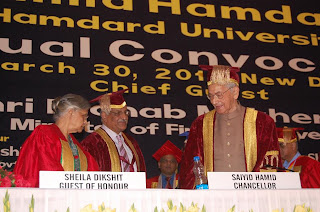
New Delhi, Mar 30 (UNI) Delhi Chief Minister Sheila Dikshit was today conferred with honorary doctorate in recognition of her leadership and service in public and community life by Hamdard University during its 19th convocation here.

Chancellor of Jamia Hamdard, Hamdard University, conferred DSc, Honoris Causa on the Chief Minister.

Expressing pleasure, Ms Dikshit said, ''I am overwhelmed on receiving the doctorate. Although I do not know how much I deserve this, to work for the society has always been my passion.''

The doctorate was also conferred on Founder-Chairman of Infosys Technologies N R Narayana Murthy, who was present on the occasion.

''Spurred by encouragement, we assure to continue to work harder to make this country a much better place for our future generations,'' he said.

Union Finance Minister Pranab Mukherjee also graced the occasion.

All the dignitaries paid rich tributes to the founder Padmashree late Hakim Abdul Hamid Sahib, who led to the setting up of the institute.

A total 1,340 students were awarded degrees for various courses, out of which 46 were PhD degree holders and 60 were gold medalists.

Pranab 'da' inspires youth towards skill development


New Delhi, Mar 30 (UNI) Union Finance Minister Pranab Mukherjee today talked about his vision of transforming India from a ''degree seeking'' system to a ''skill acquiring'' system and encouraged the country's youth to contribute largely towards attaining it rapidly.

''Skill development is a key factor for the economic and social growth of the country. Although many initiatives have been taken by the Government in this regard, they have to be multiplied for a rapid transformation,'' Mr Mukherjee said.

Referring to Prime Minister's Council on National Skill Development, the Finance Minister said it has a mission of creating 50 crore skilled people by 2022.

''A beginning has been made with approval of three projects by National Skill Development Corporation, a public and private sector partnership initiative to create 10 lakh skilled manpower at the rate of one lak per annum,'' he said.

Mr Mukherjee was speaking at the ninth annual convocation ceremony of Jamia Hamdard, Hamdard University here.

Calling it an exciting phase of India's growth story, he emphasised that issues, including strenghthened food security, improved educational opportunities and better health facilities, needed to be addressed and have to be brought forth at household
level, both in urban and rural areas.

''These issues require significant resources and we have to find those resources,'' Mr Mukherjee said.

The Union Minister further said quick revert to the high GDP growth path of nine per cent and then finding the means to cross the 'double digit growth barrier' have also to be taken care of.

In addition, weaknesses in government systems, structures and institutions at different levels of governance also needed attention.

''Our system of governance including economic governance must work towards economic empowerment and make growth human-specific,'' he said.

Chief Minister Sheila Dikshit, Founder-Chairman of Infosys Technologies N R Narayana Murthy and Chancellor of Jamia Hamdard Saiyid Hamid also graced the occasion with their presence.

Friday, February 19, 2010

Union Budget 2010-11: Expectations in health, education sectors


New Delhi, Feb 18 (UNI) As Finance Minister Pranab Mukherjee is all set to table the Union Budget for the fiscal 2010-11 on February 26, various civil society organisations are keeping their fingers crossed while expecting high from it.

Taking view of problems like non-allocation and underutilisation of resources for various schemes under the Centre, the Centre for Budget and Governance Accountability (CBGA) and Oxfam India yesterday demanded increased allocation for flagship schemes in health and education from this year's budget besides effective
utilisation of the allocated resources.

''Our concern is where would common man, who form the heart of the budget, stand in the Union Budget 2010. There is a need for greater allocation for the health and education schemes besides better utilisation and accountability and commitment towards them for the uplift of SCs and STs,'' Oxfam India Chief Executive
Officer Nisha Agrawal said.

Underlining the facts revealed after a series of people's consultations held by the CBGA across the country with support from Oxfam India, Ms Agrawal noted that the UPA-led government had promised a hike in public spending on education to six per cent of the GDP.

''However, the overall public spending on education continues to remain at a low of 3.37 per cent of the GDP,'' she said.

She claimed that the Union Government has not been able to allocate even 50 per cent of the total outlays in several schemes like Mid Day Meal, Teacher Training Institutions and Rashtriya Madhyamik Shiksha Abhiyan.

''Moreover, the Right of Children to Free and Compulsory Education Act, 2009 has also not been notified yet,'' Ms Agrawal pointed out.

Analyst Praveen Jha of the Centre for Economic Studies and Planning of the Jawaharlal Nehru University was also present on the occasion.

He argued that the combined budgetary allocation for health stood at a meagre 1.04 per cent of the GDP for 2008-09, despite the fact that the UPA had made a commitment in the National Common Minimum Programme in 2004 that total public spending on health in the country would be raised to two to three per cent of the GDP.

''However, it stands at a meagre 1.04 per cent of the GDP for 2008-09 (Revised Estimates),'' Head of CBGA Yamini Mishra said.

''The government had promised upgradation of every district headquarters hospital and their strengthening to provide quality health facility, but nothing is visible even close to it,'' she added.

She further said the state of schemes for the uplift of scheduled castes and scheduled tribes was also not impressive.